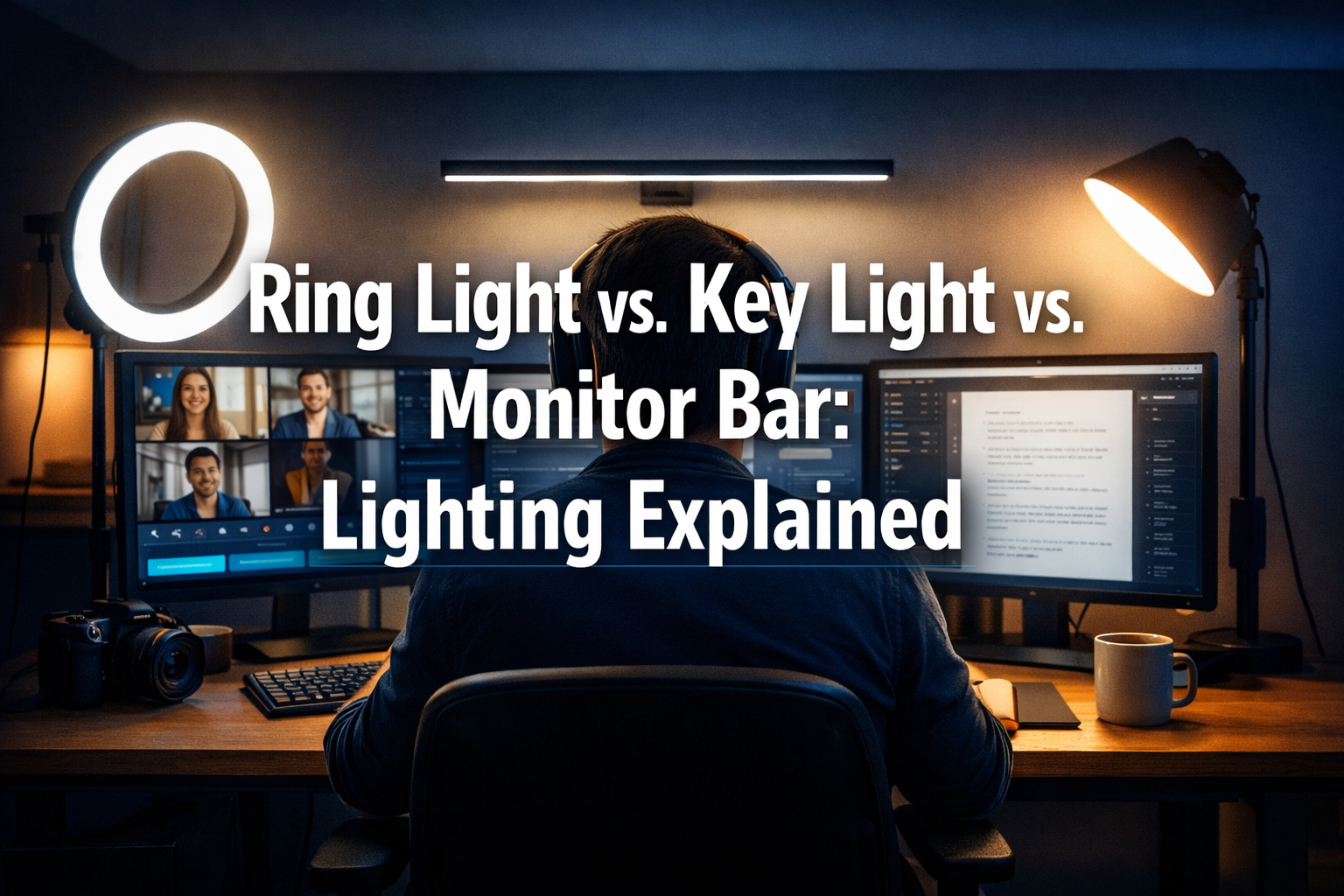

In the increasingly digital landscape of 2026, where video calls, live streaming, and content creation are everyday norms, proper lighting has moved from a luxury to an absolute necessity. The struggle with unflattering glare, harsh shadows, and poor visibility can undermine even the most polished professional presentation. Whether you're pitching to clients, recording a podcast, or simply joining a family video chat, understanding the nuances of different lighting solutions is crucial. This comprehensive guide will explain the critical differences between a ring light, a key light, and a monitor bar, helping you master your illumination setup. Dive into "Ring Light vs. Key Light vs. Monitor Bar: Lighting Explained" to transform your visual presence.
Key Takeaways
- Ring Lights Excel for Even Facial Illumination: Ideal for vloggers and beauty content, providing a soft, shadow-reducing glow, but often cause reflections in glasses.
- Key Lights Offer Versatility and Professionalism: These are the foundational lights in a multi-point setup, capable of soft, directional light with careful placement and diffusion.
- Monitor Light Bars Combat Eye Strain and Save Space: Perfect for desk-bound professionals, they illuminate the workspace without screen glare or taking up valuable desk real estate.
- Diffusion is Key to Softness: Regardless of the light type, using diffusers, softboxes, or bouncing light off surfaces is crucial for achieving a flattering, professional look.
- Room Shape and Existing Light Matter: The environment significantly influences lighting choices; open spaces allow for bounce lighting, while smaller rooms might benefit from compact solutions like monitor bars.
The Problem with Ring Lights (Reflection in Glasses)
Ring lights have become ubiquitous, especially among content creators, beauty influencers, and anyone needing a quick, affordable way to brighten their face. Their design – a circular array of LEDs – offers a unique benefit: it casts an even, almost shadowless light directly onto the subject's face. This characteristic is precisely what makes them so popular for minimizing wrinkles, dark circles, and providing a flattering glow. The light originates from all around the camera lens, effectively wrapping the face in illumination.
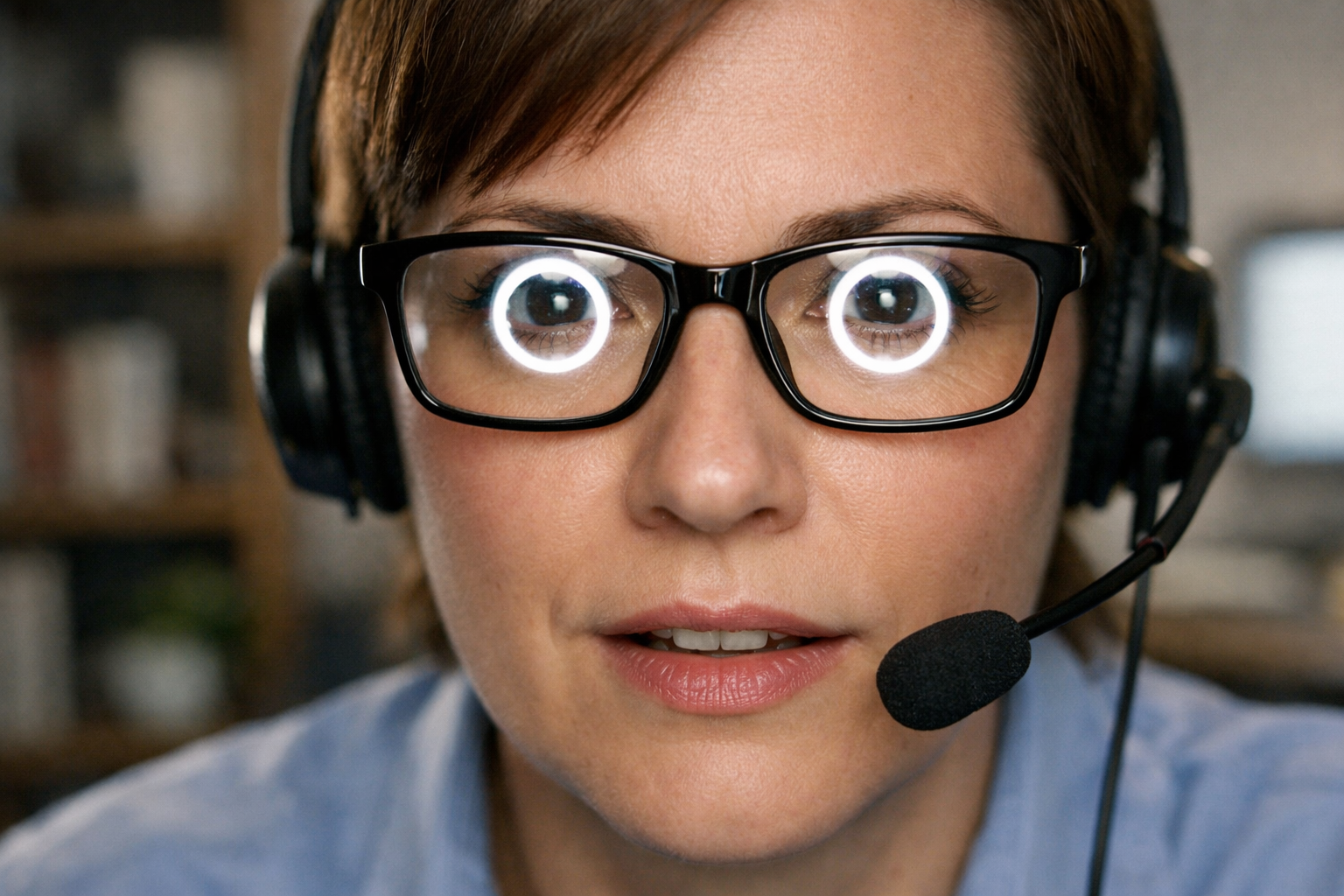
However, this very design presents a significant drawback, particularly for individuals who wear glasses. The distinctive circular shape of the ring light, when positioned directly in front of the subject and camera, often creates a clear, often distracting, circular reflection in the wearer's lenses. This "ring eye" effect can be highly undesirable in professional settings, during interviews, or any situation where maintaining eye contact and avoiding visual distractions is paramount.
“While ring lights offer unparalleled evenness, their signature reflection in glasses can undermine professionalism.”
To mitigate this, users often attempt to adjust the angle of the ring light or their head, but this can compromise the intended even illumination. Sometimes, simply moving the ring light slightly off-axis can help, but it may also reintroduce shadows. For those wearing glasses consistently, a ring light might not be the optimal primary lighting solution. Other challenges include:
- Limited Directionality: While great for evenness, a ring light doesn't offer much in terms of shaping light or creating depth, which is often desired for a more cinematic or professional look.
- Harshness at High Brightness: Without proper diffusion, some ring lights can still feel harsh, especially if placed too close to the subject.
- Space Requirement: While generally compact, a ring light setup still requires a stand and a dedicated space, which can be an issue in smaller environments.
For a deeper dive into optimizing your digital presence, you might find valuable insights on how to secure various scholarships for international students, which often require excellent video interview skills.
Bouncing Light Off Walls for a Softer Look
Moving beyond the direct and often challenging illumination of a ring light, one of the most effective and professional techniques for achieving soft, flattering light is to bounce it off a larger surface. This method leverages the principle of diffusion, transforming a potentially harsh, direct light source into a broad, gentle glow. This technique is often employed with a "key light" – the primary light source in a three-point lighting setup.
A key light is typically a single, more powerful light source than a ring light, often equipped with a softbox or diffuser. However, even without these accessories, bouncing the light can achieve superior results. Here’s how it works and why it’s so effective:
- Increased Surface Area: When light hits a wall or a large reflector, it scatters and spreads out over a much larger area before reaching the subject. This effectively makes the light source much bigger from the subject's perspective. The larger the light source relative to the subject, the softer the shadows and the more gradual the transitions between light and dark.
- Reduced Harshness: Direct light creates sharp, defined shadows and can highlight skin imperfections. Bounced light, by contrast, softens these shadows, creating a more flattering and natural appearance. It wraps around the subject more gently, mimicking natural window light on a cloudy day.
- Natural Fill: Bouncing light off a wall can also provide a natural fill light, reducing the need for additional equipment. The ambient light reflecting from the wall helps to lift shadows on the unlit side of the face, creating a more balanced exposure.
- Color Considerations: The color of the surface you bounce light off is crucial. A neutral white wall is ideal, as it won't introduce unwanted color casts. If you bounce off a colored wall, your subject will be tinted with that color.
Implementing Bounced Lighting
- Placement is Key: Position your key light to shine onto a nearby wall, preferably one that is directly opposite you or slightly to the side. Experiment with distances; moving the light closer to the wall often results in a broader, softer spread.
- Angle Matters: The angle at which the light hits the wall and then reflects back to you will influence the direction and quality of the bounced light. Aim for an angle that illuminates your face evenly without creating new harsh shadows.
- Reflectors: If a suitable white wall isn't available, a large white foam board or a professional reflector can serve the same purpose. These are portable and can be positioned precisely.
For those looking to optimize their home office or content creation space, understanding lighting is as vital as the opportunities for global career advancements, such as welding jobs with visa sponsorship in New Zealand. A well-lit environment can make a significant difference in how you present yourself professionally.
This technique, especially when considering "Ring Light vs. Key Light vs. Monitor Bar: Lighting Explained", truly highlights the versatility of a dedicated key light. It offers control and quality that direct-on lighting often cannot match, producing results that look far more professional and aesthetically pleasing.
Monitor Light Bars: Saving Desk Space and Eye Strain
In the ongoing debate of "Ring Light vs. Key Light vs. Monitor Bar: Lighting Explained," monitor light bars present a specialized solution that often goes overlooked but offers significant advantages for desk-bound professionals and casual users alike. Unlike ring lights or key lights which primarily focus on illuminating the subject, monitor light bars are designed to illuminate your workspace and, indirectly, provide a gentle ambient light for your face without creating screen glare or taking up precious desk space.
A monitor light bar is a slim, often USB-powered LED strip that clips onto the top of your computer monitor. Its unique design projects light downward and forward onto your desk, keyboard, and immediate work area, but crucially, it's engineered to prevent light from shining directly onto the screen itself. This eliminates glare and reflections that can cause eye strain.
Key Benefits of Monitor Light Bars:
- Eliminates Screen Glare: This is arguably the primary benefit. By directing light precisely where it's needed – on your desk – and away from your screen, a monitor light bar prevents reflections, making it easier to read and view content for extended periods. This contributes significantly to reducing eye fatigue, especially during long working hours in 2026.
- Saves Desk Space: In an era where many home offices are compact, every inch of desk space counts. Monitor light bars sit directly on top of your monitor, requiring no additional footprint on your desk. This is a huge advantage over traditional desk lamps or even small ring lights that occupy valuable real estate.
- Reduced Eye Strain: Working in a poorly lit environment where your screen is the brightest light source can lead to significant eye strain and discomfort. A monitor light bar balances the ambient light, reducing the contrast between your bright screen and a dark room, thereby making the overall viewing experience much more comfortable. Many models also offer adjustable color temperature (warm to cool light) and brightness, allowing users to customize their lighting to suit different tasks and times of day.
- Subtle Facial Illumination: While not their primary purpose, the light spilling from a monitor bar can offer a soft, subtle fill light for video calls. It won't be as bright or direct as a ring light or key light, but it can help diminish harsh shadows under the eyes and nose, making you look more awake and presentable without the harshness or reflections of a ring light.
- Easy Installation and Portability: Most monitor light bars are incredibly easy to install, often just clamping onto the monitor without tools. Many are also portable, making them excellent companions for those who frequently work from different locations.
Who Benefits Most?
- Remote Workers: Professionals spending hours in front of their screens for coding, writing, graphic design, or data analysis will appreciate the reduced eye strain and optimized workspace.
- Students: Ideal for late-night study sessions, providing focused light for textbooks and notes without disturbing roommates or causing fatigue. You can learn more about academic opportunities and how to excel by visiting resources like fully funded masters scholarships in Canada 2026 intake.
- Anyone with Limited Desk Space: Perfect for small home offices or shared living spaces where traditional lighting solutions are impractical.
- Casual Users: Even for browsing and casual computer use, the improved comfort can enhance the overall digital experience.
When weighing the options for "Ring Light vs. Key Light vs. Monitor Bar: Lighting Explained," the monitor light bar emerges as the champion for ergonomic desk lighting and space efficiency, offering indirect benefits for personal presentation in online interactions.
Conclusion: Picking the Right Light for Your Room Shape
Navigating the landscape of lighting options can seem daunting, but by understanding the core strengths and weaknesses of each, you can make an informed decision tailored to your specific needs and environment. The choice between a ring light, a key light, and a monitor bar, or even a combination, ultimately depends on your primary goal, your room's physical characteristics, and your budget in 2026.
Ring Lights are the champions of even, shadow-reducing facial illumination. They are excellent for close-up work, beauty tutorials, and vlogging where a bright, uniform glow is paramount. However, their distinct circular reflection in glasses remains a significant drawback for many, particularly in professional contexts. If you don't wear glasses and prioritize a simple, flattering facial light, a ring light might be your go-to.
Key Lights, especially when utilized with diffusers or the technique of bouncing light off walls, offer the most versatile and professional lighting solution. They provide directional control, allowing for depth and dimension, and can be softened significantly to create a beautiful, natural look without harsh reflections. This approach is ideal for professionals seeking a sophisticated appearance in video calls, streamers aiming for high-quality production value, and anyone serious about photographic or videographic endeavors. The ability to bounce light makes them adaptable to various room shapes, from spacious studios to more confined home offices, provided there are neutral surfaces available. Consider exploring opportunities like relocating to the UK with your family via a skilled worker visa, where a professional online presence is increasingly vital during application processes and virtual interviews.
Monitor Light Bars are the unsung heroes of ergonomic workspace illumination. They excel at reducing eye strain, saving precious desk space, and providing focused, glare-free light for your immediate work area. While they don't offer the intense facial illumination of a ring light or the creative control of a key light, they provide a subtle, beneficial ambient fill for your face during video calls without any distracting reflections. These are perfect for remote workers, students, or anyone who spends extended periods in front of a screen, particularly in smaller rooms where dedicated light stands are impractical. For instance, individuals looking for caregiver jobs in Canada with visa sponsorship could benefit from a comfortable and well-lit workspace for online training or interviews.
Actionable Next Steps:
- Assess Your Primary Need: Are you primarily concerned with facial illumination for content creation (ring light/key light), or is reducing eye strain and optimizing your workspace your main priority (monitor bar)?
- Evaluate Your Room:
- Large, open rooms with white walls: Ideal for bouncing a key light for soft, widespread illumination.
- Small, cluttered rooms: A monitor bar is excellent for saving space and providing focused task lighting. A compact key light might still work, but consider its footprint.
- Any room where you wear glasses: Lean towards a key light with diffusion or a monitor bar to avoid distracting reflections.
- Consider Your Budget: Monitor bars are often the most affordable entry point for improved desk lighting. Ring lights offer a good balance of cost and performance for facial lighting. Key lights can range from budget-friendly options to professional-grade kits.
- Experiment: Don't be afraid to try different setups. Sometimes, a combination works best – perhaps a monitor bar for your workspace and a small, diffused key light positioned off-axis for subtle facial illumination during video calls.
- Prioritize Diffusion: No matter which light source you choose from "Ring Light vs. Key Light vs. Monitor Bar: Lighting Explained", remember that softer light is generally more flattering. Invest in diffusers, softboxes, or simply use light-colored walls to bounce your light.
By carefully considering these factors, you can illuminate your world with confidence, enhancing your productivity, comfort, and professional presence in every interaction.
SEO Meta Requirements: